 HeChuang
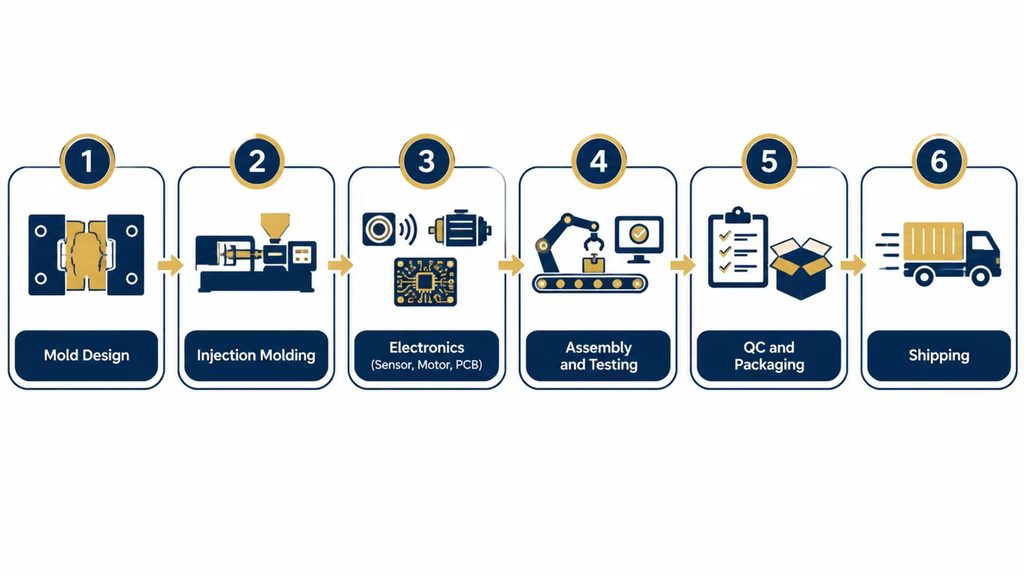
A smart trash can factory does more than screw lids onto buckets. This guide walks through the whole smart trash can factory process, from mold to finished bin, so you can see where your money goes and why lead times shift.
You don’t need an engineering degree. You just need to know where the cost and the risk sit in the chain. Work through the sections in order, because each stage explains the next.
From Design to Mold
Every smart trash can starts with a mold, and that mold is the most expensive single part.
A design moves from drawing to prototype, then to a steel mold that shapes the plastic shell. That mold sets the shape, the tolerance, and the cost of every unit that follows.
Tooling also sets the pace. A simple stock mold may already exist, while a new steel mold can take weeks to cut, polish, and test. Ask for the mold’s steel grade and expected shot count, because those two numbers set its lifespan.
Opening a new mold means a big upfront bill, which is why custom designs push the MOQ higher. If you choose a stock model, somebody else has already paid for that mold. Before you sign, check whether your order funds a new mold or borrows an existing one. It’s the difference between paying for the tool and renting the idea.
Injection Molding the Shell
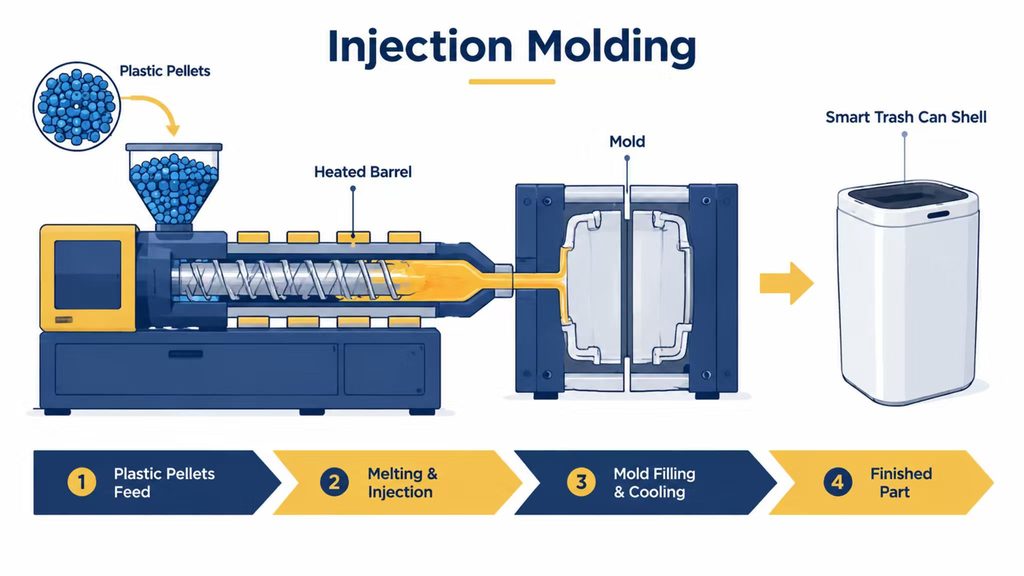
To make the shell, the factory heats plastic and forces it into the mold under pressure.
It melts ABS or PP pellets, injects them into the mold, cools the part, and ejects it. Then it repeats the cycle thousands of times.
Each cycle takes seconds to a few minutes, so factories quote a daily output. Sink marks and warping show up at this stage, and a good factory catches them before assembly.
Color and finish happen here too. The factory adds pigment or texture while the part cools, which is why changing a color mid-run slows the line.
This step also explains the volume discount. The machine and the mold are fixed costs, while the plastic itself is cheap. Spread that fixed cost across more bins, and the per-unit price drops.
The Electronics: Sensor, Motor, and PCB
Inside the bin, the smart part is a small circuit board, a motor, and a sensor. No circuit board, no ‘smart.’
The PCB runs the logic, the motor opens the lid, and the sensor reads a hand or a wave. Factories buy these parts in bulk and solder or connect them on a short line.
Sourcing matters here. A factory that buys motors from a vetted supplier and tests each batch avoids the failures that only show up later. Ask whether the firmware is already proven on other models, because rewriting it from scratch adds both cost and delay.
Most failures start in this section. A cheap motor or a weak solder joint looks fine on day one, then quits on your customer’s kitchen counter.
A factory that tests every board before assembly catches those problems early. Our sensor testing guide shows what those tests look like.
Assembly and Testing
Putting it together means joining the shell, the electronics, and the lid into one working bin.
Workers or small machines fit the sensor, motor, lid, and liner into the shell, then test each unit. A good test cycles the lid, checks the sensor range, and runs the bin for a short time.
Rhythm matters as much as the parts. A steady line with clear stations catches mistakes faster than a rushed line with one person doing everything.
This is where a factory earns or loses its reputation. A bin that works in the factory can still fail on a shelf if the team rushes assembly.
When you audit a factory, watch this line closely. Our factory audit checklist shows what to inspect on-site.
Packaging and QC Before Shipping
Before a bin ships, the factory checks it and packs it so it survives the trip.
Final QC samples the batch against AQL standards, checking the lid, the finish, and the function. After that, workers wrap, box, and load each unit with accessories and manuals.
A good factory also drop-tests the carton and checks the sea-freight packing. That step turns ‘looks fine’ into ‘arrives fine.’
Packaging matters more than it gets credit for. A bin that leaves the factory perfect but arrives cracked is still a return. If you ordered branded packaging or labels, they go on here too.
Why the Process Affects Your Lead Time
Lead time is just the sum of all these stages, and any one of them can stretch.
Mold making takes weeks, injection runs take days, and electronics assembly waits on parts arriving. That’s why a stock model ships faster than a custom one, and a new mold adds the most time. Reserve extra room in the calendar for Chinese New Year and other peak seasons, because every factory in the region slows down together.
Watch the QC gate before shipping too. A factory that skips or shortens it may promise a faster date, but you pay for that speed in returns. A clean pre-shipment inspection usually adds a day or two and removes most of the surprise.
When a factory quotes a date, ask which stage is driving it. The answer tells you whether the date is real or just hopeful. For the import and shipping side, check the official import guidance if any term looks new.
What to Ask a Factory About Its Process
A factory that can explain its process is usually a factory that controls it.
Before you commit, ask these five short questions:
| Question | Why it matters |
| Do you use an existing mold or a new one? | Reveals tooling cost and lead time |
| How do you test each unit? | Shows QC depth |
| Which parts do you buy, and from where? | Exposes supply risk |
| What is the daily output of this line? | Checks capacity claims |
| Can I see the line on a live call? | Confirms the process is real |
That said, you don’t need to know every machine. You need a factory that can explain its own line without hesitation. If you’re still choosing a supplier, our vetting guide walks through the background checks before you pay.
Frequently Asked Questions
How long does it take a smart trash can factory to make an order?
A stock model can ship in a few weeks. A custom design with a new mold adds weeks or months, because the factory must make and test the mold first.
What is the most expensive part of a smart trash can?
The mold, then the electronics. The plastic shell is cheap once the mold exists, which is why custom designs cost more up front.
How does a factory test each smart trash can?
Most factories cycle the lid, check the sensor range, and run the bin briefly. Some also test the motor and the board before final assembly.
Why do bigger orders cost less per unit?
The mold, machine setup, and shipping are fixed costs. More units spread those costs thinner, so the per-unit price falls.
Should I visit or video-check the production line?
At least a live video check is worth it. It confirms the machines, the workers, and the QC area are real, not props the factory rented for a photo.
Get a Factory-Direct Quote
A smart trash can factory is a chain of steps, and understanding the chain is how you buy with confidence instead of hope.
HeChuang Tech runs a 30,000㎡ factory with 76 models and 43 production machines, and we walk every buyer through our line on a live call. Ask for our process and a sample-first quote through the contact page, and we will respond within 24 hours.
[…] follows the mold, injection, electronics, and assembly steps we covered in the smart trash can factory guide. After that, QC samples the batch against your spec, and the goods head to the port. If this […]