 HeChuang
Smart trash can OEM means a factory builds bins to your spec and puts your brand on them. This guide walks through the whole smart trash can OEM process in plain English, so you can launch a private label line without guessing.
You don’t need to be a product designer. You need a clear spec, a patient budget, and a factory that answers questions before you pay. Read in order, because each step feeds the next one. By the end, you’ll know exactly what to put in your first inquiry and which questions to ask before the sample.
What Does Smart Trash Can OEM Mean?
In short, OEM stands for original equipment manufacturer. In this business, it means a smart trash can factory makes a bin for you and puts your logo, colors, and packaging on it. The phrase simply describes who supplies the finished product: the factory makes it, your brand sells it.
People often confuse OEM with ODM. With OEM, you bring the design or spec, and the factory builds it. With ODM, you pick a ready design the factory already owns and add your brand on top. If that split still feels fuzzy, our OEM vs ODM guide breaks it down side by side.
Why Buyers Choose OEM
OEM lets you sell under your own brand instead of reselling someone else’s product. That is the whole pitch in one sentence, and for most private label buyers it is enough.
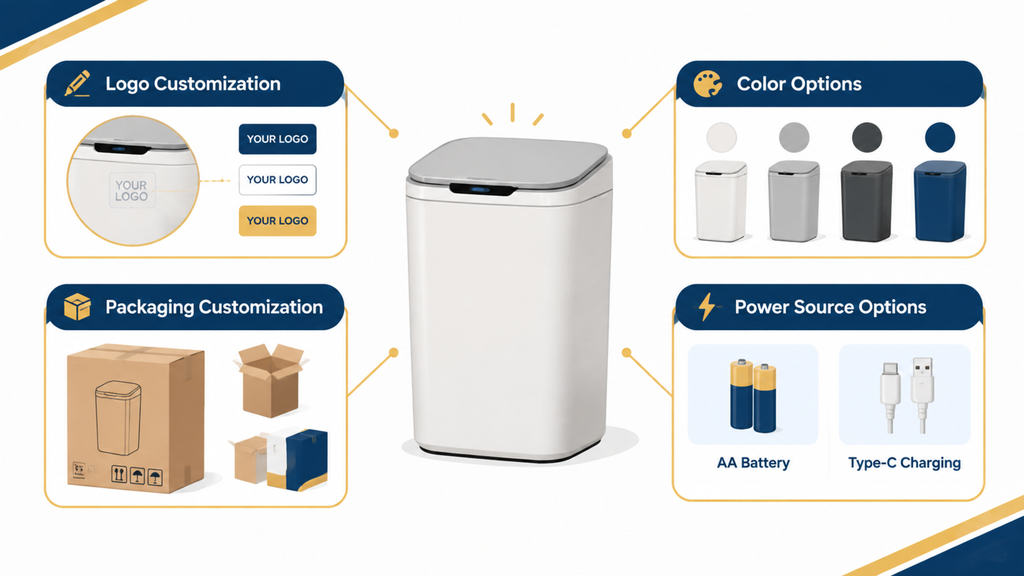
Own branding is the main draw, because it builds customer trust and repeat orders. You also control the power source (AA battery or Type-C), color, sensor settings, and packaging, so the product fits your market from the first shipment.
There is a tradeoff, and it is worth naming out loud. You take on more upfront work and a higher MOQ than a stock ODM order. Many brands accept that trade because the margin and the brand equity land on their side, not the factory’s.
That control also makes pricing cleaner. You set the retail price and the brand story, instead of competing on price with ten other sellers of the same bin.
The OEM Process Step by Step
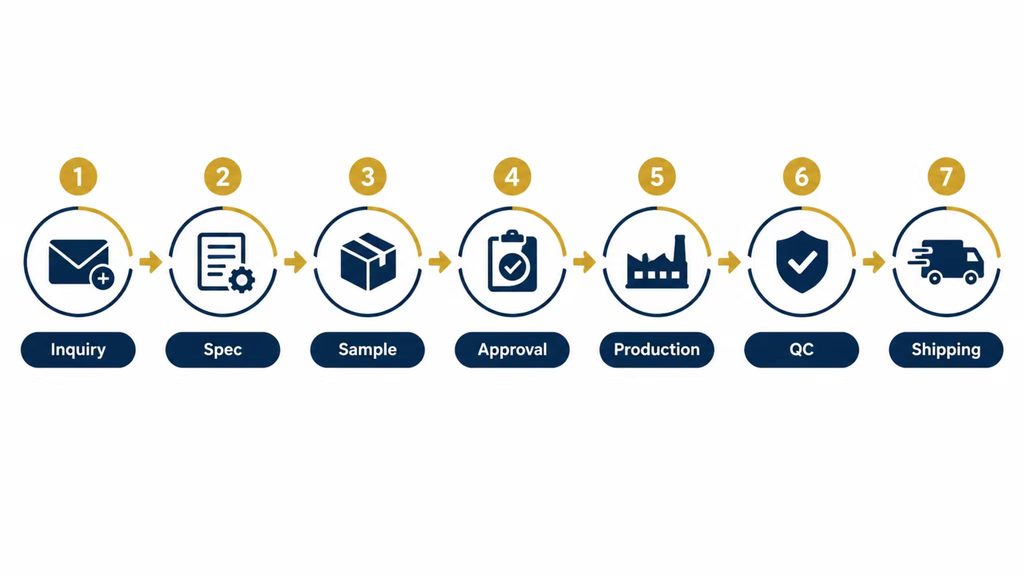
A clean OEM order follows seven steps: inquiry, spec, sample, approval, production, QC, and shipping. Seven sounds like a lot, but each one is small and only the sample step feels slow.
You start by sending your target market, quantity, and any drawings or photos. The factory replies with a quote, a timeline, and a list of decisions you still need to make. Expect a few rounds of back-and-forth here, because a clear spec saves weeks later.
Next comes the sample. Most factories ask you to cover the tooling or sample unit, and that sample becomes your contract in physical form. Touch it, test it, and sign it off before you approve anything.
Treat the sample like a rehearsal, not a formality. A change made now costs days; the same change after production starts costs containers.
Production follows the mold, injection, electronics, and assembly steps we covered in the smart trash can factory guide. After that, QC samples the batch against your spec, and the goods head to the port. If this is your first import, check the official trade guidance so the paperwork does not hold up the delivery.
What You Control in an OEM Order
You control more than the logo, but you don’t control everything, and that’s fine. Control what sells, and let the factory handle what it does best.
On a standard OEM order, you choose the brand name and logo, the shell color, the packaging and manual, the power source (AA battery or Type-C), and the sensor settings. Those are the changes that matter most to a retail buyer. Some factories also let you set firmware defaults, like how long the lid stays open or how sensitive the sensor is.
Deeper changes, like a new capacity or a reshaped lid, need new tooling and more time. That level crosses into a custom smart trash can, so ask early where your idea sits on that line.
OEM MOQ and Lead Time
Your MOQ and lead time depend on how far you customize, not on the word ‘OEM’ itself. That is the honest short version, and it saves you from comparing two quotes that are not really comparable.
A light OEM order, such as a logo and packaging on an existing model, often starts at a modest MOQ and can ship in a few weeks. New tooling pushes both numbers up, sometimes by a lot.
If a small first run matters most, start with a stock model and add branding later. Our low MOQ guide explains how to keep the opening order small without stalling the launch.
Leave buffer in the calendar for sample approvals and holiday slowdowns, because both eat into your launch date. A late sample or a quiet factory week has cost more launches than any competitor has.
Common OEM Mistakes to Avoid
Most OEM problems come from skipped steps, not from bad factories. A factory can be honest and skilled and still ship the wrong product if the brief was vague.
Here are the five mistakes that come up most often, and what each one really costs you:
| Mistake | Why it costs you |
| Skipping the sample | You approve a product you have never held |
| Unclear spec sheet | The factory guesses, and you pay for the guess |
| Wrong power source | The bin fails in your target market |
| Over-customizing too early | A high MOQ before you have proven demand |
| No QC gate before shipping | Defects arrive at your customer’s door |
None of these are exotic. They are ordinary, avoidable, and worth putting on a checklist before you pay a deposit.
What to Ask Before You Start
Ask these five questions before you commit to any OEM order.
| Question | Why it matters |
| Can I see a sample of a similar model? | Proves the factory has done this before |
| What is the MOQ for my exact spec? | Sets your cash and warehouse commitment |
| Which parts can I change, and which stay fixed? | Shows where your control ends |
| What is the lead time with my changes? | Tells you when you can launch |
| Will I see QC photos or a video before shipping? | Confirms you won’t buy blind |
That said, you don’t need to read a catalog cover to cover. You need clear answers, and a factory that gives them without stalling.
Frequently Asked Questions
What is the difference between OEM and ODM in smart trash cans?
OEM means you bring the spec and the factory builds to it. ODM means the factory already has a design and you add your brand on top. OEM gives you more control; ODM is usually faster and cheaper to start. Think of OEM as ‘build to my spec’ and ODM as ‘re-brand what already exists.’
How much does smart trash can OEM cost?
Cost depends on quantity, customization depth, and whether you need new tooling. Instead of one flat number, ask for the unit price, the tooling cost, and the sample fee as separate lines so nothing hides. That way you can compare two factories on the same three numbers.
Can I order a small quantity for my first OEM run?
Usually yes, if you keep the changes light. A logo and packaging on a stock model can often start at a modest MOQ; a brand-new mold cannot.
How long does an OEM order take?
A light order can ship in a few weeks. New tooling adds weeks or months, plus sample approval time. Ask the factory which stage drives the date, then build your launch calendar backward from that date.
Who owns the mold I pay for?
Usually the factory owns it, unless your contract says otherwise. Ask this before you pay, and put the answer in writing. A short line in the contract today prevents a long argument later.
Get an OEM Quote
Smart trash can OEM is a straightforward process when the spec is clear and the factory answers plainly. Start with the spec, not the sales pitch, and the rest of the process falls into place.
HeChuang Tech runs a 30,000㎡ smart trash can factory with 76 models, 43 production machines, and CE, FCC, and RoHS certification. Tell us your target market and the features you need through the contact page, and we will send a sample-first OEM plan within 24 hours.
Leave a Reply