 HeChuang
The china trash can supplier scam is a real pattern, and it repeats every week in sourcing forums. A buyer on Reddit thought he had found a solid factory. Then he noticed the license number on the supplier’s quote matched a different company. Another buyer sent money through a transfer app the supplier insisted on, and the supplier vanished with the deposit. Those stories explain why importers stay nervous about China suppliers. This guide gives you a red flags checklist to spot a fake Chinese trash can supplier. You also get a four-step verification you can run from your desk, plus the payment rules that protect your deposit.
Why the China Trash Can Supplier Scam Keeps Working
Smart trash cans are a crowded category with real money in it, so a typical order runs into thousands of dollars and the payoff for a fake supplier is high. The fraud patterns repeat too. One buyer found that the license number on his supplier’s proforma invoice matched an unrelated company, a classic shell-company move. Another veteran importer’s advice is blunt: stay inside the trading platform and never step outside it. Those two stories capture the two biggest tells, license reuse and off-platform pressure, and both appear again in the checklist below. In short, the scams are not clever; they just exploit buyers who are in a hurry.
The variations are endless, but the money flow stays the same, so every china trash can supplier scam story shares one structure. In one pattern, the fake supplier arranges an “inspection” that charges you a fee, then reports everything as fine even though no visit ever happened. In another, the supplier quotes a low price, takes the deposit, and asks for “extra customs fees” a few weeks later. Both end the same way: your money moves somewhere you can’t trace. That’s why the checklist looks at payment and proof, not just at price. And the checklist works for any product, but the examples here are trash-can specific, because that’s where these stories cluster.
The 8 Red Flags Checklist
Work through these eight flags before you trust any quote. They come straight from china trash can supplier scam reports, so any single flag deserves a hard question.
| Red flag | What it looks like | Why it matters |
| 1. Payment to a personal account | The supplier asks you to pay an individual, not the company account | Traceable payment disappears, so recovery gets hard |
| 2. No live factory video | A photo album instead of a video call, or “the factory is busy” | A real factory can show its line in a short live call |
| 3. License or address mismatch | The license number repeats another company, or the address doesn’t match the website | License reuse is the classic shell-company tell |
| 4. Price undercuts every other quote | The number sits far below all competing quotes | Missing lines hide in that gap, so the final cost jumps later |
| 5. Certificates without your models | A CE/FCC/RoHS logo appears, but no model family is named | Real certificates name the products they cover |
| 6. Pressure to leave the platform | “Message me off-platform for a better price” | Protections inside the platform don’t follow you out |
| 7. Silence after payment | Deposit paid, then delayed replies and new excuses | Take-the-money-and-vanish is the oldest pattern |
| 8. Same certificate template as others | The cert layout matches another “factory’s” files | Stock templates circulate among fake sellers |
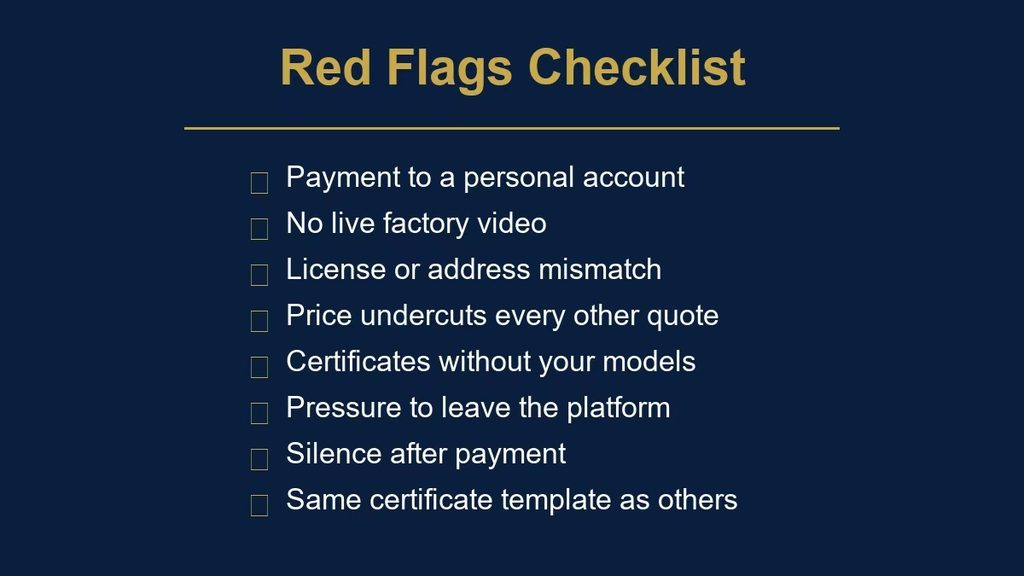
Two flags above decide most cases, so they deserve extra weight: who receives the money, and whether you can see the factory live. Everything else is supporting evidence. When both of those fail, walk away, whatever the price looks like. When both pass, the remaining flags are easy to check in a single afternoon.
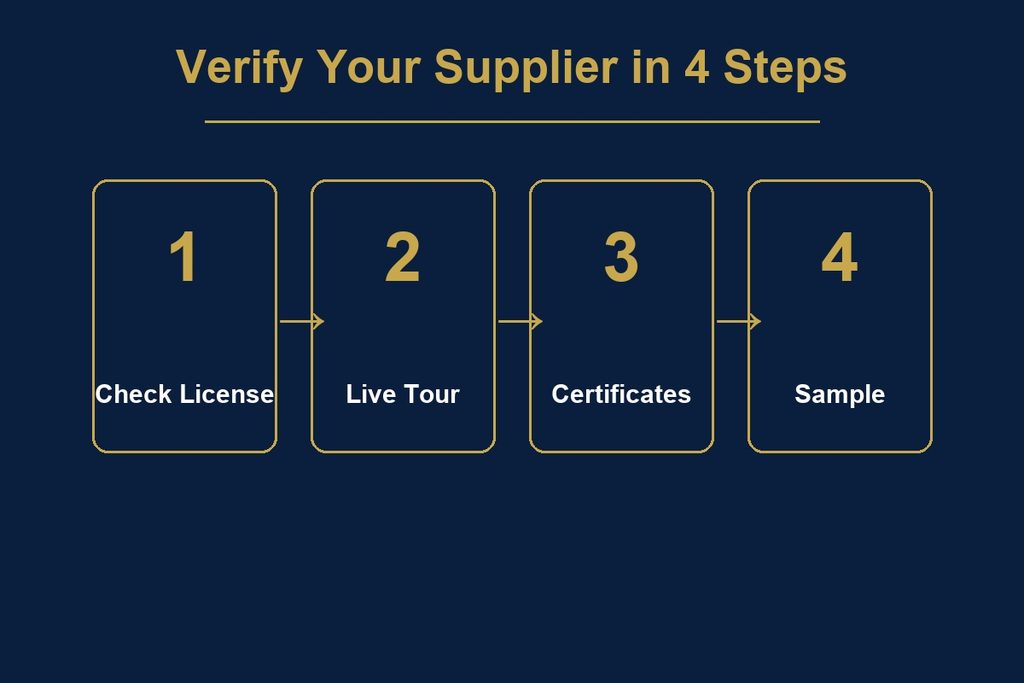
How to Verify a Supplier in 4 Steps
You can check most of these flags from your desk in a single afternoon. Here’s the sequence we recommend, and it’s the same one we accept from our own buyers.
Step 1: Check the business license
Ask for the license, then look up the number in the official public registry. For China, that system is gsxt, the National Enterprise Credit Information Publicity System, and it’s free. Confirm three things: the registered company name, the legal address, and that the name matches your invoice and website. If the numbers don’t line up, stop and ask why before you pay anything.
Step 2: Demand a live factory tour
A short video call that walks the production line kills most fake suppliers, because they have no line to show. Real factories run live tours as a routine sales step. At HeChuang Tech, for example, we schedule live video tours of the workshop so buyers can see the injection machines and assembly benches before they order. In our experience, buyers who do a live tour before the deposit rarely end up in dispute, because they saw exactly what they paid for.
Step 3: Ask for certificates that name your models
A certificate is only useful when it names the products it covers. So ask for the certificate number and the model family, then check it against the issuing body’s database where one exists. Ask the supplier to add your target models to the next certificate update, because a certificate that names your models is the one customs and retailers accept.
Step 4: Order a sample before the bulk order
A sample order is the cheapest audit you can run, and at HeChuang Tech samples are charged with the cost returned on a repeat order. Test the sample against your checklist, not against the photos. Then scale up only when the physical unit matches the claims.
Payment Rules That Protect Your Deposit
Most buyers who lose money to fake suppliers describe the same sequence. The price was attractive, the supplier was responsive, and the payment method felt normal until it wasn’t. That’s why the rules below are strict, and why we follow them ourselves. In practice, a china trash can supplier scam usually dies at the payment question, because a real factory answers it in one sentence.
The safest rule is simple: pay the company, not a person, and keep the payment traceable. Any push toward a personal account or a non-standard channel is a red flag on its own, whatever the excuse sounds like. Agree on the payment milestones in writing before you transfer anything, so both sides know exactly what triggers each payment.
Here’s our own commitment, so you can see the standard: every HeChuang Tech order is paid to our corporate bank account, and we never ask buyers to transfer to a personal account or a non-standard channel. We also provide our business license for verification, and we support live video factory tours. That combination is the baseline you should demand from any supplier. If a factory hesitates on any of it, the hesitation is an answer.
Frequently Asked Questions
These are the questions buyers ask us most after a scare, and the answers stay deliberately plain.
Should I pay through a transfer app the supplier insists on?
A supplier who insists on a non-standard transfer channel is showing you a red flag, not doing you a favor. Use a traceable, documented payment method that you control, and treat anything else as a reason to pause.
How do I check a Chinese company license?
Look up the license number in the official registry (gsxt), then compare the registered name and address with your invoice and the website. A mismatch or a reused number means stop and verify again.
Why does a live video call matter so much?
Because a real factory can show its line in minutes, and a fake one can’t. Photos and certificates are cheap to copy, but a live production line is not.
What if I already sent money to a suspect supplier?
Act fast. Contact your bank or payment provider and explain the fraud, save every chat log and invoice, and report the supplier on the platform where you found them. The odds of recovery drop the longer you wait, so don’t wait for politeness.
Is a very low price always a scam?
No, but a price far below the range deserves a hard question, because something has to be missing. Ask for the full quote structure, then compare totals rather than headline prices. Our guide on smart trash can import costs shows the full breakdown.
How do I verify a certificate?
Ask for the certificate number and the model family it names. Where the issuing body keeps a public database, check the number there. And remember the rule from Step 3: a certificate that names your models is the one that protects you.
Get the Paperwork in Writing
The best defense is a contract that names the supplier, the payment milestones, and the certificates, in writing. Our guide on how to vet a Chinese smart trash can factory walks through the deeper checks, and our factory audit checklist gives you a printable list for a visit or a video call. HeChuang Tech runs a 30,000 m2 factory with 43 production machines, 150+ staff, and CE, FCC, and RoHS certifications. Every document we hand to a buyer is checked the same way, so the license, the certificates, and the invoice always carry the same company name. We collect through corporate accounts, we arrange live video tours, and we share our license for verification. Or contact us with your target market and volume, and we’ll reply within 24 hours.
Leave a Reply