 HeChuang
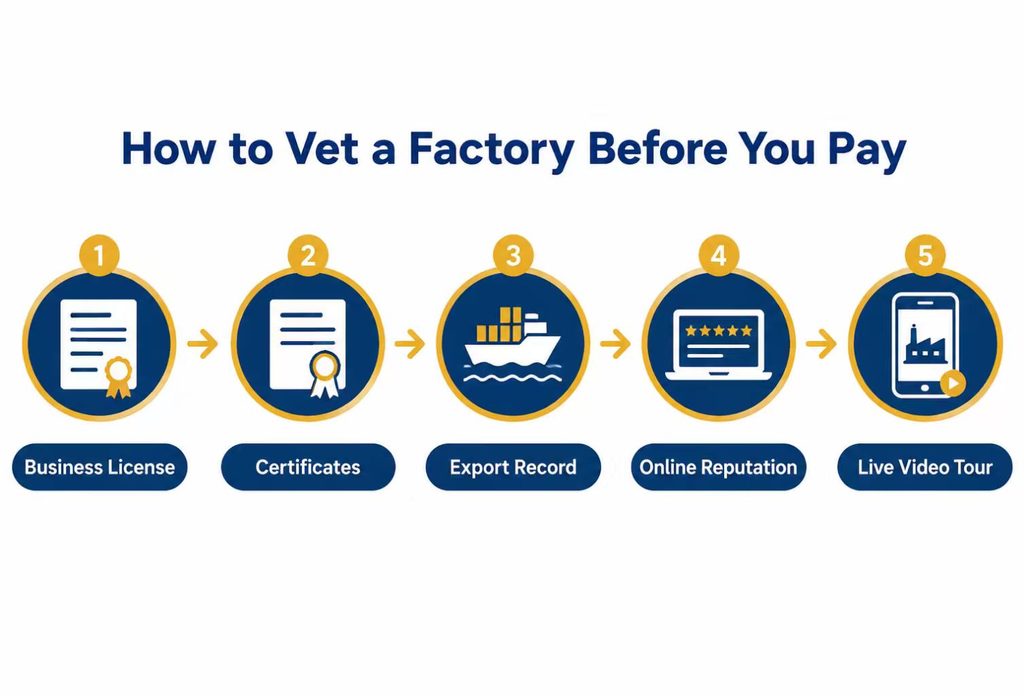
The single most important rule of sourcing in China is simple: vet the factory before you send money, not after. This guide walks through how to vet a Chinese smart trash can factory in five checks. You can finish all five before the deposit leaves your bank. If a supplier cannot pass these checks, walk away, because there is always another factory behind it.
You don’t need a private investigator. You need documents, records, and one honest video call. Most red flags show up in the paperwork long before they show up in a container of defective bins. Work through the checks in order, because each one makes the next one cheaper and faster.
Check the Business License and Scope
The cheapest check is the first one: read the business license.
Every Chinese factory operates under a registered business scope. A company licensed to trade hats cannot quietly pivot to smart trash cans. Ask for the business license and the export license, then check both against the official registry. The name on the license should match the name on the invoice, the contract, and the bank account. If any of them differ, that is not a small detail; it is a warning sign. Look at the scope for the words manufacturing or production. Also check the registered capital and registered address, because a factory registered at a home address with tiny capital often signals a shell rather than a production site. A trading company can still be useful, but you should know which kind of company you are actually dealing with before you pay.
Verify the Certificates Are Real
Certificates are the most faked document in sourcing, so never accept a PDF at face value.
CE, FCC, and RoHS are the three marks that matter for smart trash cans sold into Western markets. Ask for the certificate number, the issuing body, and the product model it covers. Then verify that number on the issuing body’s public database. A valid CE mark means the product meets European safety rules. FCC covers the radio and electronics for the US. RoHS limits hazardous substances. Make sure the model on the certificate matches the model you are ordering, because some factories show a certificate for one product and ship another. Some buyers skip this step because it feels technical, but a fake certificate is exactly the mistake that turns a cheap quote into a customs headache. For a plain-English explanation of what each mark means, see our certification explainer.
Check the Export Record and Customers
A factory that exports regularly leaves a paper trail you can read.
Ask which countries they have shipped to and which customers they have worked with. A factory selling into Europe, North America, or Japan has already passed stricter buyer checks, so that history lowers your risk. Request two or three references and actually contact them. You will not always get a name, and that’s normal, because customers guard their supply chains. But a factory that claims big retail clients yet cannot produce one verifiable shipment is telling you something. If the factory only lists vague phrases like ‘many European clients’ with no names, dates, or ports, ask for specifics. Where you can, cross-check the export record against customs data, because volume claims are easy to make and harder to prove.
Dig Into the Online Reputation and History
How long a factory has been around matters more than how pretty its website is.
Check the registration date, any name changes, and any legal disputes. A factory that renames itself every two years is often running from something. Search the company name alongside words like complaint, dispute, and scam, then read the results with a skeptical eye. On Alibaba and similar platforms, look at the trade assurance history and dispute record too. In practice, a ten-year-old factory with a boring website beats a one-year-old factory with a slick one. In this business, age is evidence. A clean record does not prove everything, but a messy one tells you to slow down.
Ask for a Live Video Factory Tour
Never trust a video that the sales team could have recorded anywhere.
Ask for a live video call where the supplier walks through the production floor, the QC area, and the warehouse. Watch for the details that are hard to fake: machines actually running, workers at their stations, and your product category on the line. If they refuse a live tour or only offer polished clips, treat that as a red flag. Ask them to hold up a note with the date and your name at the start, because that kills the trick of recycling an old recording. Ask them to pause at the QC bench and show a test in progress, because that is the part of the factory that keeps defective lids off the boat. A live tour is the closest you get to a factory visit from your desk.
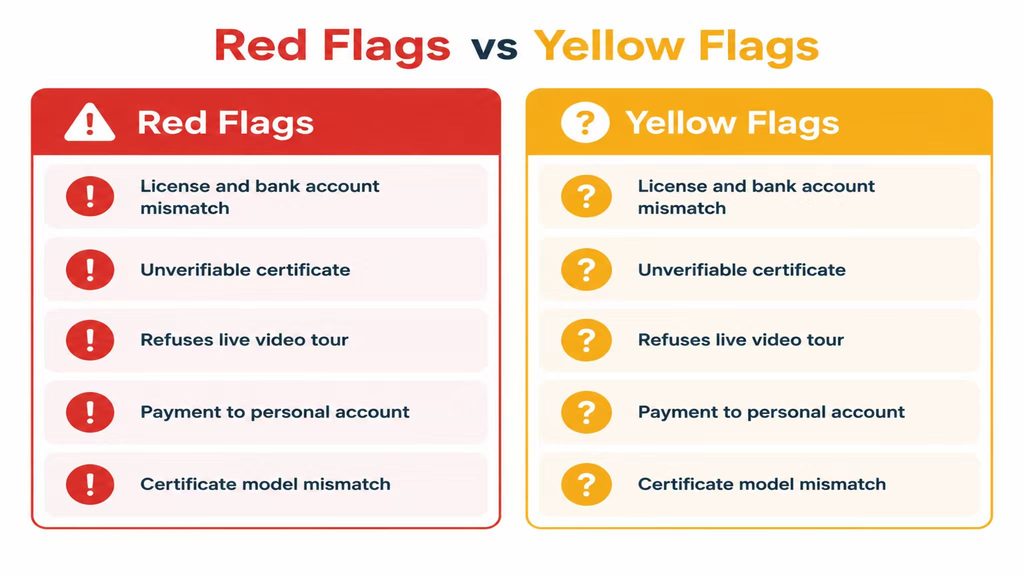
How to Vet a Chinese Smart Trash Can Factory: Red and Yellow Flags
Some issues are deal breakers, and others just deserve a second question.
The table below sorts them for you, so you can act on the big ones and investigate the small ones.
| Red flag (walk away) | Yellow flag (ask more) |
| License name doesn’t match the bank account | No verifiable export history |
| Certificate number won’t verify | Won’t share references |
| Refuses a live video tour | Slow to answer document requests |
| Asks for payment to a personal account | Claims big clients but shows no proof |
| Certificate model differs from your order | Registered for less than two years |
That said, a yellow flag is not a rejection; it is a follow-up question. Two or three yellow flags on the same factory usually add up to one big red one. So trust the pattern more than any single item. Once a factory passes this screen, our factory audit checklist walks through what to inspect on-site.
Frequently Asked Questions
How do I vet a Chinese smart trash can factory without visiting?
You can vet a Chinese smart trash can factory without leaving your desk. Verify the license and certificate numbers, check the export record and disputes, and end with a live video tour. If all of those line up, a physical audit becomes a bonus rather than a necessity. You miss the smell and the floor conditions, but for a first screen the paperwork and the live walkthrough cover the risks that actually cost money.
What is the first document I should ask for?
The business license. It shows the real legal name, the registration date, and the approved scope of business, and you measure every other check against it.
How can I check that a CE certificate is real?
Ask for the certificate number and the issuing body, then look the number up on that body’s public database. Confirm the product model on the certificate matches your order before you pay.
Is it normal for a factory to refuse to share references?
Partially. Many customers keep their suppliers private, so a short reference list is normal. A flat refusal paired with no export history is a bigger concern than a short list.
What is the biggest red flag before payment?
A mismatch between the license name and the bank account, or a request to pay into a personal account. Both usually mean the money is going somewhere the contract does not cover.
Get a Factory-Direct Quote
Vetting a factory is not about distrust; it is about paying for bins instead of paying for a lesson.
HeChuang Tech makes the background check easy. We share our license, our CE, FCC, and RoHS certificates, our export markets, and a live video tour of our 30,000㎡ factory with 76 models. We also send sample photos and specification sheets before you commit. Read our guide on choosing a smart trash can manufacturer, or reach out through the contact page for documents and a quote within 24 hours.
Leave a Reply