 HeChuang
Introduction: OEM vs ODM — What’s the Difference and Why It Matters
If you’ve spent any time sourcing smart trash cans from China, you’ve seen these three letters everywhere: OEM and ODM. Suppliers throw them around in Alibaba listings, WhatsApp messages, and quotation emails. And if we’re being honest, most first-time buyers nod along without really knowing which one they need.
I get it. The terms sound technical. But here’s the thing: choosing between OEM and ODM isn’t a minor detail. It determines your MOQ, your lead time, your unit cost, whether you own the product design, and how fast you can get to market. Pick the wrong model, and you’re either overpaying for capabilities you don’t need or locking yourself into a product anyone else can sell.
This article breaks down both models — clearly, without the jargon — so you can decide which path fits your brand.
What Is OEM? — Your Design, the Factory Builds It
OEM stands for Original Equipment Manufacturing. In plain terms: you bring the design, the factory makes it.
This is the model for buyers who want something nobody else has. You define the shape, the material, the sensor placement, the lid mechanism, the internal dimensions — everything. The factory’s job is to turn your specification into a physical product.
Here’s what that looks like in practice for smart trash cans: You might come to us with a sketch of a slim-profile sensor bin with a brushed gold finish, a custom ring LED indicator, and a silent-close lid. We build a mold from scratch based on those specs. That mold is yours — exclusively. No other buyer can use it. The product that comes off that mold? Nobody else sells it.
The trade-offs are real. Custom molds take 40 to 60 days to fabricate and test before a single unit rolls off the line. The mold cost is negotiated based on complexity — the more intricate the design, the more work goes into the tooling. MOQs are also negotiated per project, because the factory needs to schedule dedicated production runs for a product that doesn’t exist yet.
But the upside is significant: you own the design. If your product sells well, no competitor can show up six months later with the identical unit at a lower price — because only one factory in the world has the mold.
OEM is the right call when you have a clear vision for a differentiated product and the volume to justify dedicated production.
What Is ODM? — Factory Design, Your Brand on It
ODM stands for Original Design Manufacturing. The factory has already designed, engineered, and tooled the product. Your job is to brand it and sell it.
This is by far the more common starting point — and for good reason.
A factory like ours has invested in developing dozens of smart trash can models: different capacities, shapes, finishes, sensor types. The molds already exist. The production line is already calibrated. The supply chain for components is already humming. When you place an ODM order, you’re essentially buying a seat on a train that’s already moving.
What “branding it” actually means varies by depth. At the lightest level, you’re adding your logo — screen-printed or laser-etched onto the body of the bin. At the next level, you’re customizing the color to match your brand palette, designing your own packaging with your brand’s visual identity, and including your own user manual. Some buyers go further and modify surface finishes, switch out sensor modules, or adjust internal dimensions slightly — changes that don’t require new tooling but do make the product feel more like theirs.
The advantages are speed and accessibility. Because the molds are ready, samples ship within 7 days. MOQs start around 100 units. You can test a market, validate demand, and have product in a warehouse within weeks — not months.
The limitation: you don’t own the design. The same base product, under different brand names, may appear on other shelves. If you’re building a brand on differentiation, ODM alone won’t get you there forever.
OEM vs ODM — A Side-by-Side Comparison
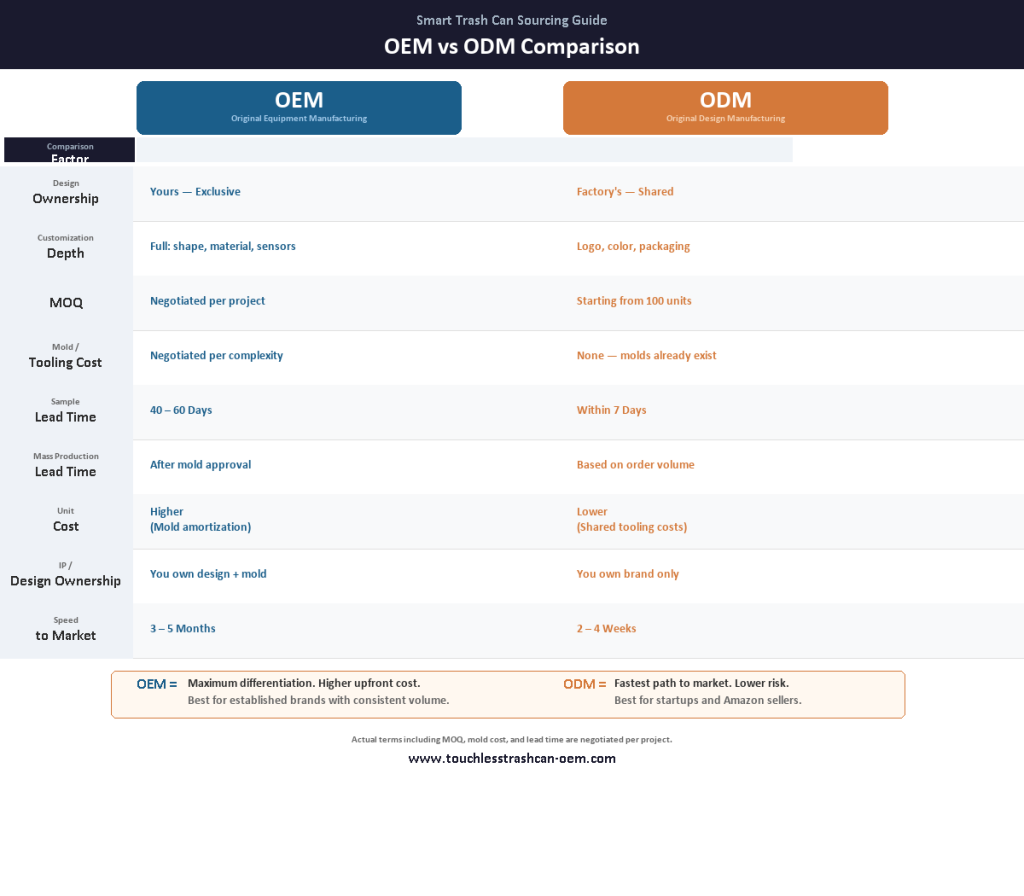
| Factor | OEM | ODM |
|---|---|---|
| Design Ownership | Yours — Exclusive | Factory’s — Shared |
| Customization Depth | Full: shape, materials, sensors | Logo, color, packaging |
| MOQ | Negotiated per project | Starting from 100 units |
| Mold / Tooling Cost | Negotiated per complexity | None — molds already exist |
| Sample Lead Time | 40 – 60 Days | Within 7 Days |
| Production Lead Time | After mold approval | Based on order volume |
| Unit Cost | Higher (mold amortization) | Lower (shared tooling) |
| IP / Design Ownership | You own design + mold | You own brand only |
| Speed to Market | 3 – 5 Months | 2 – 4 Weeks |
Which One Is Right for You?
The honest answer: it depends on where you are in your business journey. Here’s how I’d think about it by buyer profile — and this comes from talking to hundreds of buyers who source smart trash cans from China. A surprising number of them came to us after picking the wrong model elsewhere.
If You’re Launching a Brand from Scratch: Start with ODM
You don’t need a unique mold to test whether the market wants a stainless steel sensor trash can with your logo on it. Start with an existing ODM model. Brand it. Sell 500 or 1,000 units. Learn what your customers actually care about — is it the finish? The sensor response speed? The quiet-close mechanism? Once you have real sales data and customer feedback, you’re in a much smarter position to invest in an OEM project that addresses exactly what your market wants.
If You’re an Amazon FBA Seller: ODM, but Think Incremental Differentiation
Most Amazon sellers I work with start with ODM — logo printing on a proven model, custom packaging, their own listing photography. It works. But the smart ones plan ahead: after the first reorder, they ask the factory what modifications are possible without new tooling. A different sensor sensitivity range. A matte finish instead of glossy. A custom ring light color. Small changes that make the product harder to copy exactly. None of these require a full OEM commitment, but over time they add up to meaningful differentiation.
If You’re an Established Brand with Consistent Volume: OEM Builds a Moat
When you’re moving thousands of units per month and your brand has real equity, the calculus changes. A custom mold that costs several thousand dollars amortized over 20,000 units barely moves the unit economics. And the exclusive design becomes a durable competitive advantage. Nobody can undercut the same product because nobody else has the tooling to make it. That’s the moat.
How Hechuang Supports Both — Without Locking You Into One Path
One thing that trips up a lot of buyers: some factories only do ODM, some only do OEM. If you start with ODM and want to graduate to OEM later, you’re switching suppliers — and losing all the relationship capital you built.
That’s not how we work.
At www.touchlesstrashcan-oem.com, we support both models — and we support buyers who transition between them. Our factory has 67 smart trash can models available for ODM, covering 8 to 13 gallon, 14 to 23 gallon, and above 23 gallon capacities. Every model can be branded with your logo, color-matched to your palette, and packaged in your custom design.
For OEM projects, our in-house mold development team works directly with you. The timeline from design lock to sample approval is typically 40 to 60 days, with regular progress updates and photos at key milestones — so you’re never in the dark.
Most importantly, there’s a natural path: start with ODM to validate your market, then move to OEM when you’re ready to build a defensible product. Same factory, same team, no relationship reset.
Conclusion: Pick the Model That Matches Your Stage
OEM and ODM aren’t good-versus-bad decisions. They’re timing decisions.
ODM gets you to market fast with low upfront investment — perfect for testing, learning, and building initial traction. OEM builds a durable competitive moat — the right move when you have proven demand and the volume to support it. Most successful brands do both, in sequence.
Not sure which model fits your current situation? Contact us for a no-pressure consultation. Tell us about your market, your volume expectations, and your brand vision. We’ll walk you through the options that make sense for you — not the ones that make us the most money.
To view more info, check:
· How to Choose a Smart Trash Can Manufacturer
· How to Import Smart Trash Cans from China
[…] between private label and full custom design? Our OEM vs ODM explainer spells out the […]
[…] answers all five clearly and with evidence is one worth your next step.To view more info, check:· Smart Trash Can OEM vs ODM· Sensor Testing & […]