 HeChuang
Sensor Lifespan Is the Question Buyers Worry About Most
A smart trash can has one job — open when someone approaches and close when they walk away. The infrared sensor is the component that makes that happen. In fact, it is the part buyers worry about most, because it is usually the first thing to fail: a lid that opens slowly, triggers on its own, or stops responding altogether.
In sourcing conversations, buyers often confuse sensor lifespan with battery life. However, battery life is only part of the story. Depending on the model, a fresh set of AA batteries or a full Type-C charge keeps a unit running for about two to three months. Sensor lifespan is different: it means the lid keeps opening and closing reliably across tens of thousands of uses — with the same response time and sensing range every time.
For importers, that is exactly where smart trash can sensor testing matters. For example, a unit that works on day one is easy to make look good in a showroom video. But a unit that still works after thousands of open-and-close cycles is the result of a repeatable trash can QC process — not luck.
What We Test: Response, Lifespan, and Cycle Count
We measure three things on every sensor-driven trash can, because together they define whether the product feels reliable in a kitchen, office, or public space:
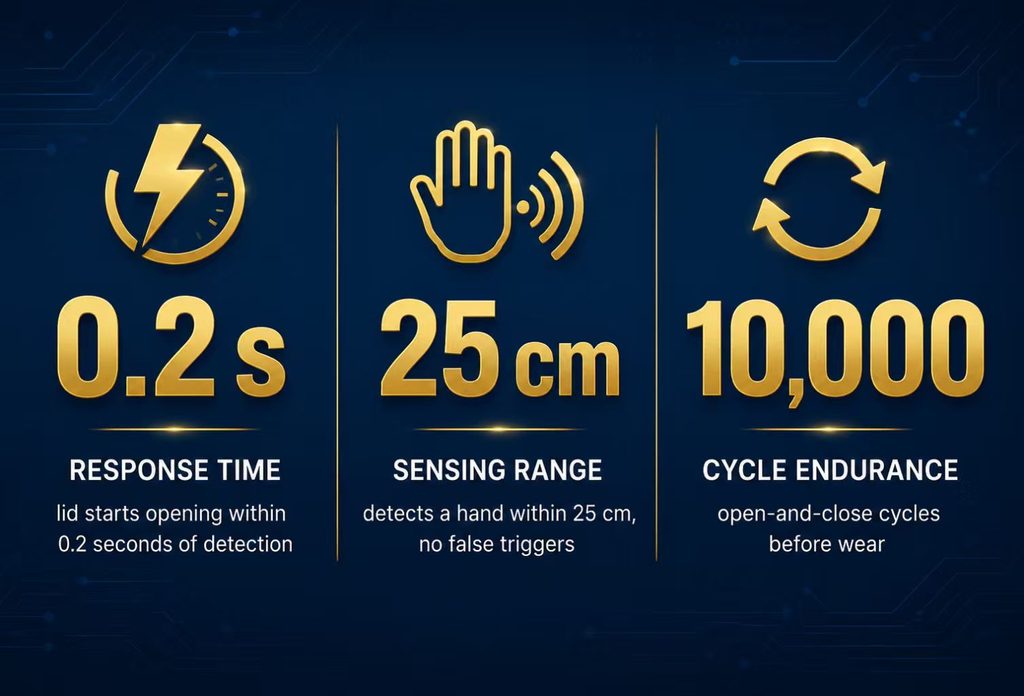
- Response time — 0.2 s. The lid should start opening within 0.2 seconds of detection. Otherwise, anything slower feels laggy, and delay is one of the first complaints an end buyer notices.
- Sensing range — up to 25 cm. The sensor should detect a hand within 25 cm and hold that trigger consistently, without false triggers from across the room.
- Cycle endurance — 10,000 open-and-close cycles. The lid mechanism is validated against a 10,000-cycle benchmark, so it keeps working after months of daily use rather than wearing out in the first season.
How the Smart Trash Can Sensor Testing Process Works
The testing follows the product through the production line rather than happening once at the very end:
- Incoming check. First, we inspect the sensor board and lid motor when components arrive, before they reach assembly.
- Function check. Then, we verify response time and sensing range against the 0.2 s and 25 cm specifications.
- Cycle endurance validation. Next, we run the mechanism through repeated open-and-close cycles to confirm it meets the 10,000-cycle benchmark.
- Final functional inspection. Finally, before packing, every unit receives a 100% functional full inspection — not a visual spot check.
The point of this sequence is simple: you want to catch a sensor problem on the line, not in a customer’s kitchen. That’s why each stage has a pass/fail gate. As a result, a unit that misses the response, range, or cycle standard never moves on to the next step.
What to Ask Your Supplier For
If you are comparing suppliers, ask for the same three numbers in writing — response time, sensing range, and the cycle endurance benchmark — along with the documents that back them up:
- Certifications. CE, FCC, and RoHS for the markets you sell into. We covered what each mark means in our guide to smart trash can certifications.
- Third-party test reports. Independent product test reports tied to the exact model you are buying, not a generic family declaration.
- QC policy. Also, confirm whether final functional inspection is 100%, and whether the factory accepts your own sampling inspection or a third-party inspection before shipment.
In fact, here is one extra signal: a factory that holds patents on some of its models usually has a real engineering team behind the product, not just a trading office.
How QC Backs Up the Testing
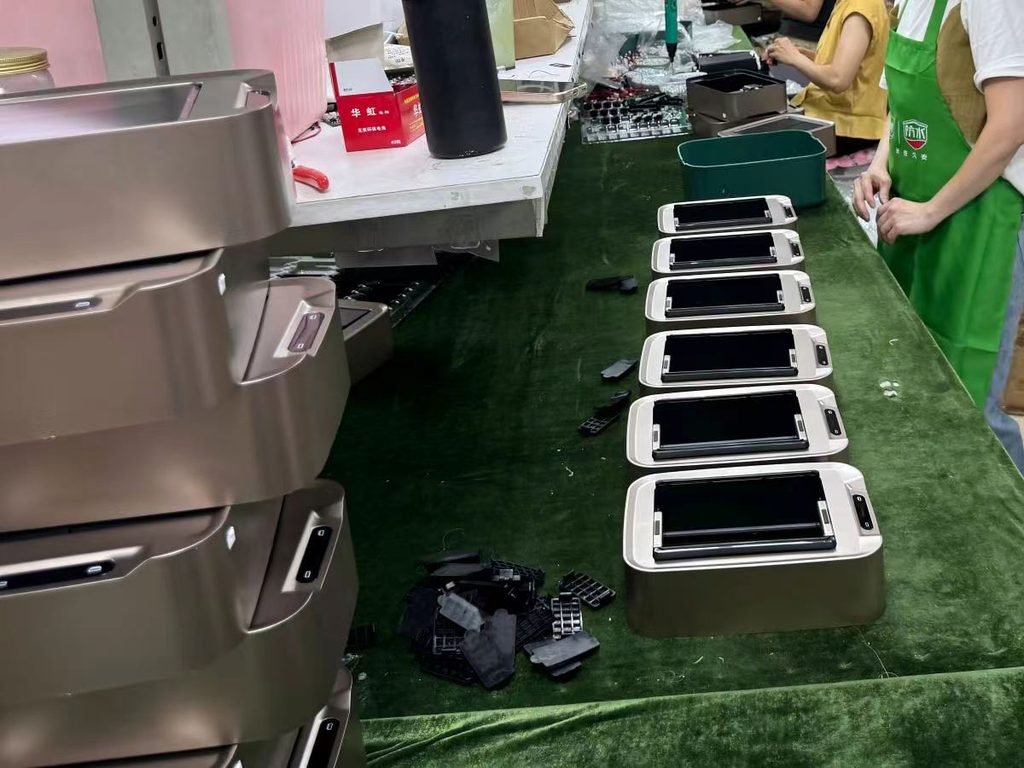
Documentation means little if it does not match what the line actually builds. That is why we tie sensor test results to the physical quality control process: incoming component inspection, first-piece confirmation, in-line checks, and 100% functional full inspection before packing.
After our inspection, you are welcome to run your own random sampling inspection or bring in a third-party inspection team. We build the process to be verified, not hidden. Also, we keep CE, FCC, RoHS, and third-party test reports matched to the model you order. See how the line works on our Quality & Testing page.
Conclusion — Tested Before It Ships, Verified After It Arrives
Sensor reliability is one of the few sourcing risks you can measure in advance. In short, three numbers tell you most of what you need to know: 0.2 s response time, up to 25 cm sensing range, and a 10,000-cycle endurance benchmark. As a result, a factory that shares them openly has nothing to hide.
Ready to check the specs on a specific model? Then browse the range on our Products page, or Contact us for the sensor test data together with your quote.
To view more info, check:
· CE, FCC & RoHS Certifications
· How to Choose a Smart Trash Can Manufacturer
[…] The answers you get will tell you more about a supplier than any catalog or price list ever could. A smart trash can manufacturer in China that answers all five clearly and with evidence is one worth your next step.To view more info, check:· Smart Trash Can OEM vs ODM· Sensor Testing & QC […]
[…] Ready to get real numbers? Tell us which series you’re considering, your target market, and your estimated volume, and we’ll come back with a quote, not a brochure. Contact us to get started.To view more info, check:· CE, FCC & RoHS Certifications· Sensor Testing & QC […]
[…] view more info, check:· Sensor Testing & QC· How to Import Smart Trash Cans from […]