 HeChuang
Introduction: Pick the Series That Fits Your Buyer
Choosing the right smart trash can types comes down to one thing: who your end customer actually is. If you’re selling to hotels and premium offices, the stainless steel double-door series is your play. Residential buyers and online volume point to the plastic sensor series. And for public, high-traffic spaces, the 50L stainless double-door is the obvious pick.
That part is easy. What trips people up is figuring out what those differences cost them in real terms. Unit price, MOQ, durability, how the product holds up in the real world. So let me walk through the three series the way I’d explain them on a sourcing call.
The Three Smart Trash Can Types, Side by Side
I put the basics in a table because most sourcing decisions come down to six questions: what it’s made of, how it opens, how big it is, what certificates it carries, who buys it, and who the end user is.
| Factor | Stainless Steel | Sensor (Plastic) | Commercial (50L) |
| Material | Stainless steel | ABS + PP plastic | Stainless steel |
| Opening | Sensor + button | Sensor | Sensor + button |
| Capacity | 15L / 35L / 50L | 12L to 40L | 50L |
| Certifications | CE / FCC / RoHS | CE / FCC / RoHS | CE / FCC / RoHS |
| Target Market | Hotels, premium offices | Residential, e-commerce | Public spaces, high-traffic |
| Typical Customer | Hotel suppliers, brand projects | Amazon sellers, online retailers | Facility managers, commercial buyers |
Stainless Steel Double-Door Smart Trash Cans: Built to Be Seen
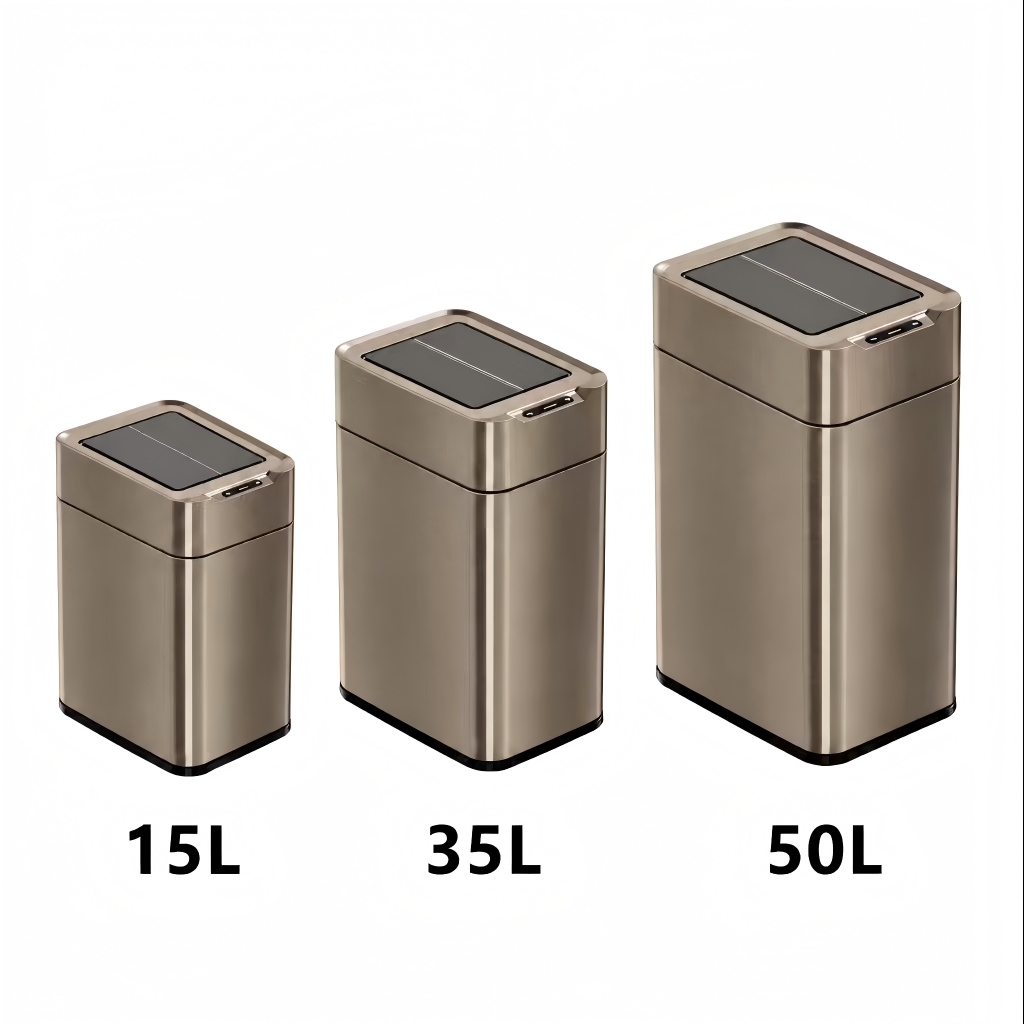
When a buyer asks for stainless steel, they’re usually not thinking about the metal itself. They’re picturing how the bin looks next to a marble counter, or wondering whether it can survive a hotel housekeeping crew for three years.
That’s exactly what this series is for. The body is stainless steel, which matters in humid environments and anywhere a plastic bin would eventually look scratched and tired. It comes in three capacities (15L, 35L, and 50L) and opens two ways: a motion sensor for hands-free use, plus a physical button for anyone who prefers direct contact.
Buyers tend to miss two details until they actually use the product. The sensor triggers at about 25cm and the lid opens in roughly 0.2 seconds, so nobody has to wave twice. There’s also a built-in LED light inside the bin. That sounds like a small thing until you’re dropping trash into a dark corridor at night.
Power is flexible too. The stainless double-door comes in a Type-C rechargeable version and an AA battery version. Either way, a full charge or fresh batteries lasts about two to three months in normal use.
Plastic Sensor Smart Trash Cans: The Volume Play
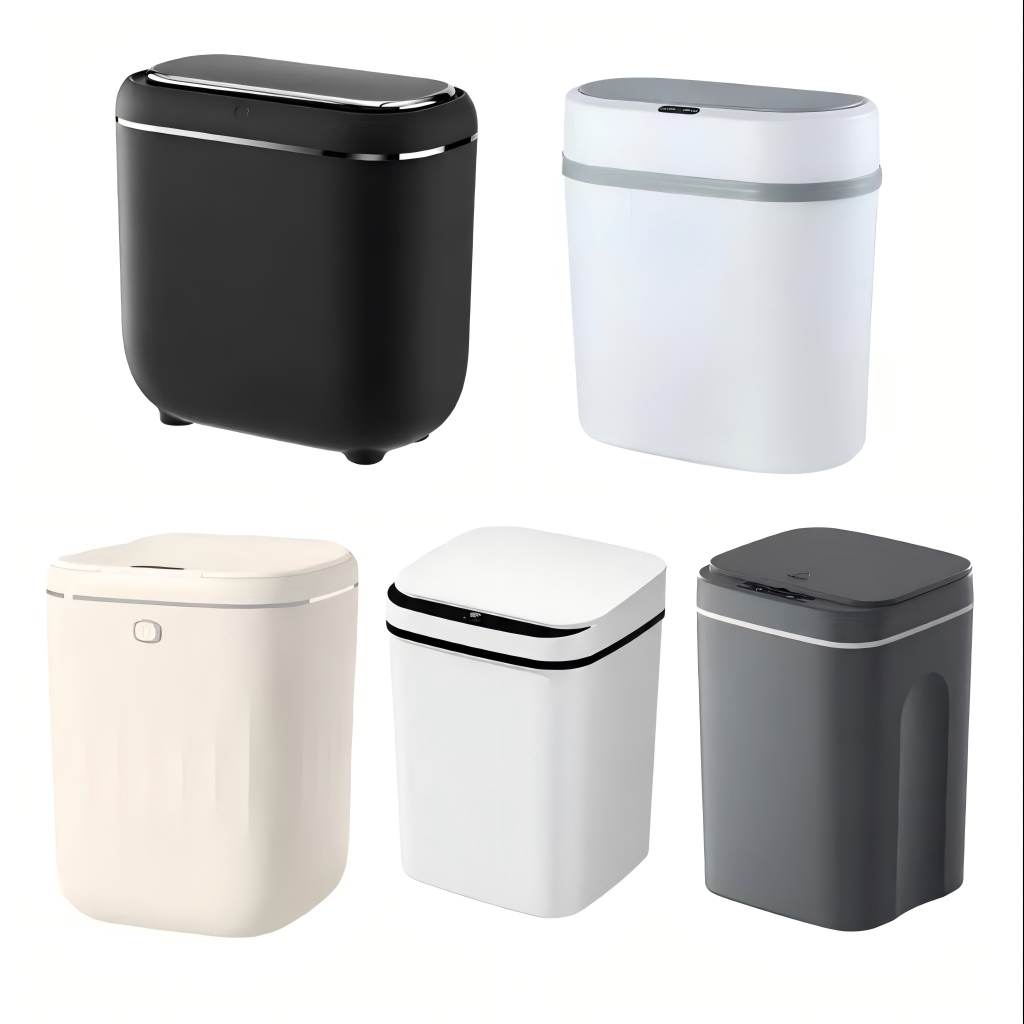
If you sell on Amazon or run an online store, this is where most of your volume will come from. The sensor series is our widest line, with 67 models spanning 12L to 40L, and the unit economics are built for retail. For sensor trash can OEM and private-label work, this line is usually the fastest path to market.
The body is ABS + PP plastic, which keeps both tooling and per-unit cost down without making the product feel flimsy. The lid is sensor-operated and uses the same 25cm sensing distance and 0.2-second opening speed as the stainless line.
The real advantage is flexibility. With that many models, you aren’t stuck with one shape. You can pick a compact 12L model for small apartments, a 30L model for family kitchens, or a 40L model for shared spaces, and still keep a consistent brand look across the range.
Power comes from standard AA batteries on every plastic sensor model, with some models also available in a Type-C rechargeable version. Fresh batteries or a single charge keeps the bin running for about two to three months in normal use.
Commercial Smart Trash Cans: The 50L Workhorse
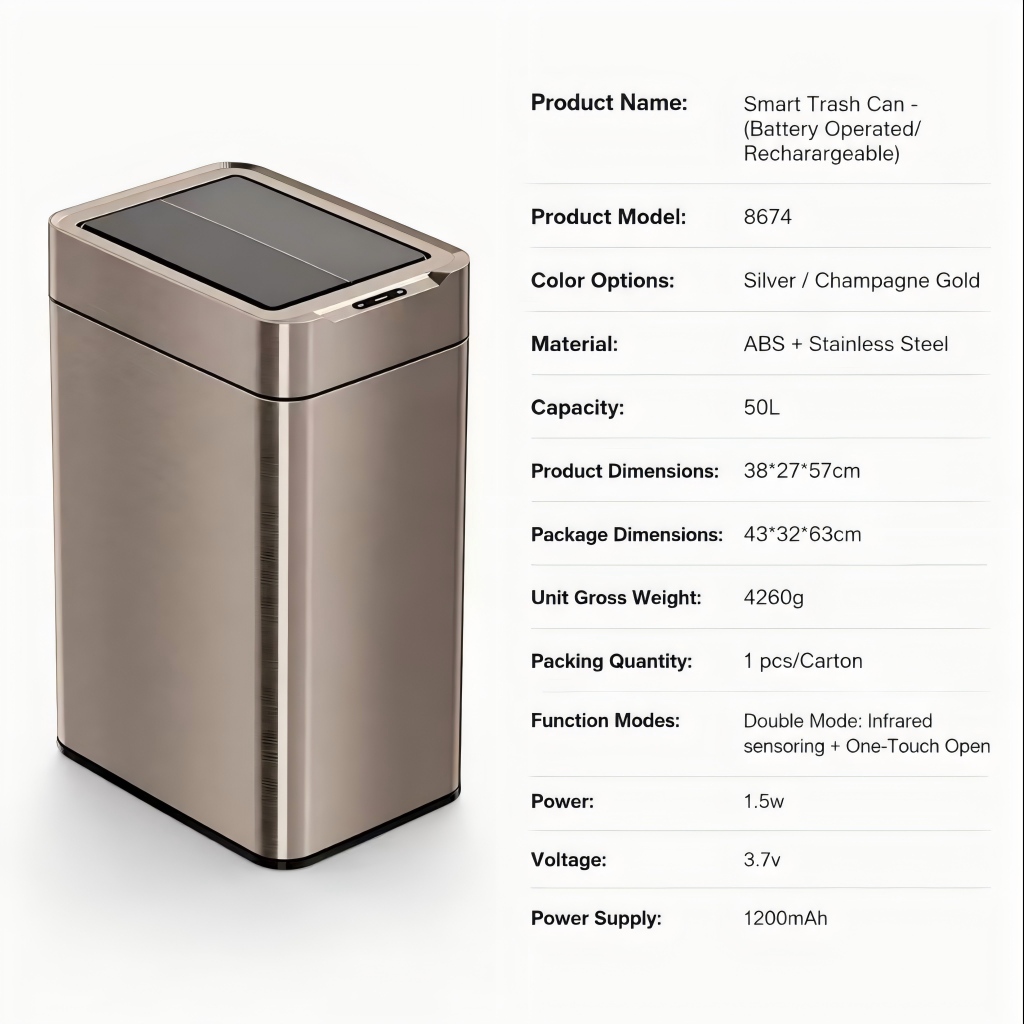
This is the one I point buyers to when they say they need something for a busy public space. The 50L stainless steel double-door is the largest model in the stainless range, and it’s the one we position for commercial use: lobbies, gyms, airports, office kitchens, anywhere a bin gets opened hundreds of times a day. If the commercial label sounds like a separate product, it isn’t. It’s simply the 50L version of the stainless series, aimed at high-traffic buyers.
Why not just use a smaller bin? Capacity is the first reason. At 50L, staff change bags far less often, which matters when they’re servicing thirty bins across a building. Durability is the second. A stainless body absorbs the abuse that would leave a plastic bin scratched and clouded within months.
It has the same dual opening, sensor plus button, and the same built-in LED light. The difference is that it’s sized and built for heavy frequency. That’s why it’s the model most often requested by buyers looking for a commercial trash can manufacturer.
How to Choose by Market, Customer, and Channel
Here’s the framework I use when a buyer isn’t sure which series to lead with.
Amazon sellers and pure online retailers should start with the plastic sensor series. Lower unit cost, wide model selection, and you can test several SKUs without committing to an expensive mold. This is where volume and reviews come from.
For offline wholesale to hotels, restaurants, or corporate buyers, stainless steel is the lead. Those customers care about how the bin looks in the room as much as whether it opens. The 15L and 35L are the natural fit for bathrooms, guest rooms, and offices, which makes this range the right choice for stainless steel trash can wholesale.
Bidding on commercial projects like property management, facilities contracts, or public venues? The 50L commercial model is your anchor. It’s a capacity and durability story, and it’s the unit buyers expect to see when they walk a facility.
One warning: don’t try to cover all three series with a small first order. Pick the one that matches your strongest channel, build traction there, then expand. Spreading a thin budget across three lines usually means three weak launches.
OEM/ODM Customization Without the Guesswork
All three series can be branded with your logo, color-matched to your brand palette, and shipped in your custom packaging. That’s the baseline.
Beyond branding, the depth of customization depends on your order volume and the specific model. A small trial order and a full container program naturally get different levels of flexibility, so we don’t publish a fixed customization menu. The honest approach is to tell us your market, your quantity, and what you’re trying to achieve, and we’ll scope a realistic solution with you.
The same goes for function-level requirements. If your market needs a different sensing behavior or power configuration, that’s a conversation rather than a checkbox. Bring the requirement, and we’ll tell you what’s feasible at your volume.
Quality Control and Certifications
Every series ships with CE, FCC, and RoHS compliance, which matters the moment your container lands in Europe, the US, or any market that checks documentation at customs. If you’re importing into a region with its own rules, ask about market-specific certificates before you commit. For reference, RoHS covers hazardous substances and CE marking signals conformity for EU markets.
On the factory side, each unit goes through function testing before packing. We test the sensor, the lid mechanism, and the power system, on top of the visual check. We welcome third-party inspection if your buying process calls for it.
If you want to dig into the testing process, see our Quality & Testing page. To browse the full range, start with our Products page. And if you’re still narrowing down your options, our guide on choosing a smart trash can manufacturer is a good next read.
FAQ: Smart Trash Can Types and Series Choices
Which series should I start with if I’m new to importing smart trash can types?
Start with the plastic sensor series. Lower unit cost, no tooling commitment, and a wide range of models to test means you can validate demand before scaling. Most new sellers build their first SKUs here.
Do all three series carry the same certifications?
Yes, all three ship with CE, FCC, and RoHS. If your market needs an additional certificate, raise it early so we can confirm availability or scope a plan before you commit.
Can I mix series in one order?
It depends on volume. Mixing is usually possible once each SKU clears its MOQ, but for a first order we recommend leading with one series so your budget and marketing stay focused.
Is the stainless steel double-door worth the higher unit cost?
If your customer sells into hotels, premium offices, or humid environments, yes. The stainless body lasts longer in those settings and justifies a higher retail price. If you’re selling online volume, the plastic sensor line is the better starting point.
How do I know which capacity to stock first?
For residential and online retail, 12L to 30L models tend to move fastest. For commercial or facility projects, lead with the 50L. Match your first capacity to your strongest channel instead of stocking every size at once.
Ready to get real numbers? Tell us which series you’re considering, your target market, and your estimated volume, and we’ll come back with a quote, not a brochure. Contact us to get started.
To view more info, check:
· CE, FCC & RoHS Certifications
· Sensor Testing & QC
[…] you need a refresher on what is available, our guide to smart trash can types walks through the main options in plain […]
[…] you are still weighing sensor, pedal, and stainless styles, our guide to smart trash can types walks through the […]